


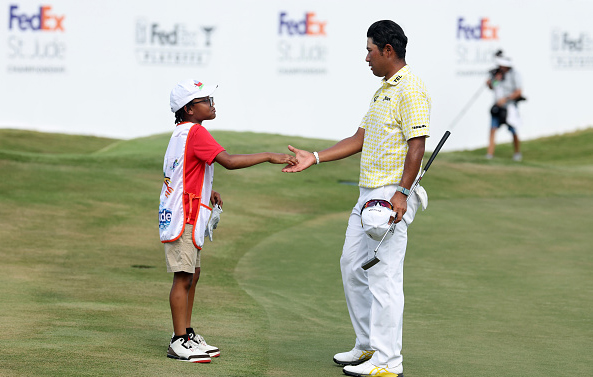
There was something almost surreal about listening to CBS spend Sunday afternoon extolling the virtues of St. Jude Children’s Research Hospital, FedEx and the PGA Tour’s decades-long relationship with Memphis.
Jim Nantz delivered the familiar reverent tones. The broadcast leaned heavily into the history. St. Jude was presented, rightly, as something far larger than a golf tournament. FedEx was celebrated as one of the sport’s most important corporate partners. The event was framed as a marriage of golf, philanthropy and civic identity.
And yet hanging over all of it was an uncomfortable reality the broadcast could not quite reconcile:
The PGA Tour is moving on.
As part of the Tour’s planned 2028 Championship Series overhaul, Memphis is not being considered for any slot on the top tier’s revamped schedule — effectively kicking one of professional golf’s longest-running corporate and charitable partnerships to the curb.
That context made some of Sunday’s television feel less like a celebration and more like an obituary nobody wanted to acknowledge.
For decades, FedEx has been about as loyal a corporate partner as the PGA Tour could possibly ask for.
The company’s involvement in professional golf stretches back to 1986. Beginning in 2007, FedEx became the title sponsor of the Tour’s season-long points race, attaching its name to the FedExCup and committing hundreds of millions of dollars to a product the Tour itself was trying to establish as the defining structure of its season.
That was not a three-year marketing experiment.
It was nearly two decades of underwriting the PGA Tour’s central competitive narrative.
FedEx helped turn the postseason into a recognizable brand. Its money was there when the Tour wanted to manufacture urgency at the end of the season. Its name became synonymous with points standings, playoff projections, television graphics and the Tour Championship.
Add it all together, and FedEx’s financial commitment to golf over four decades runs into the billions.
Memphis, meanwhile, brought something money alone cannot manufacture.
It brought St. Jude.
The hospital is inseparable from the identity of the tournament. Players visit patients. Broadcasts tell their stories. Patients are part of the tournament’s conclusion. CBS routinely devotes significant airtime to the hospital’s mission. The tournament has long been positioned as one of the PGA Tour’s strongest examples of professional golf serving a greater purpose.
That is what made Sunday’s presentation so awkward.
The same organization being celebrated for its supposed devotion to this partnership is preparing to eliminate the event from its Championship Series schedule in 2028.
There is no clean way around that contradiction.
Professional sports change. Schedules evolve. Television priorities shift. The PGA Tour has every right to believe another market or another golf course might better serve whatever vision it has for 2028.
But if that is the business decision, then call it what it is.
Do not spend an afternoon selling viewers on the permanence and virtue of a relationship the Tour has already determined is expendable.
That is where the disconnect becomes difficult to ignore.
The PGA Tour has spent years telling fans that sponsors are “partners,” that communities are part of the Tour “family,” and that charitable relationships are foundational to its identity.
Yet the coming Championship Series increasingly appears designed around television windows, marketability, scarcity and maximizing the value of the Tour’s top players.
Those may all be legitimate business objectives.
They are also very different from the sentimental language traditionally used to describe events such as Memphis.
FedEx and St. Jude are useful symbols of that tension because few tournaments could make a stronger case for institutional loyalty.
If nearly 40 years of sponsorship history, hundreds of millions of dollars behind the FedExCup, one of America’s most recognizable charitable institutions and generations of community support are not enough to protect an event, what exactly does “partnership” mean?
Apparently, it means partnership until the spreadsheet says otherwise.
CBS, of course, had a golf tournament to televise Sunday. St. Jude deserves every second of positive exposure it receives, and none of the discomfort surrounding the PGA Tour’s future plans diminishes the work being done at the hospital.
If anything, that is precisely why the contrast was so striking.
The more Nantz talked about the importance of St. Jude, the harder it became to ignore what the PGA Tour itself is preparing to do.
The more CBS celebrated FedEx’s extraordinary commitment to professional golf, the stranger it became that one of the sport’s most loyal sponsors is watching the Tour redesign its 2028 postseason without its flagship sponsor.
By the time the tributes reached full volume, the entire presentation carried an unintended undertone.
Thank you, FedEx, for nearly four decades.
Thank you, Memphis.
Thank you, St. Jude.
Thank you for the billions, the charity, the history and the loyalty.
Now please step aside. We have a new television schedule to build.


