


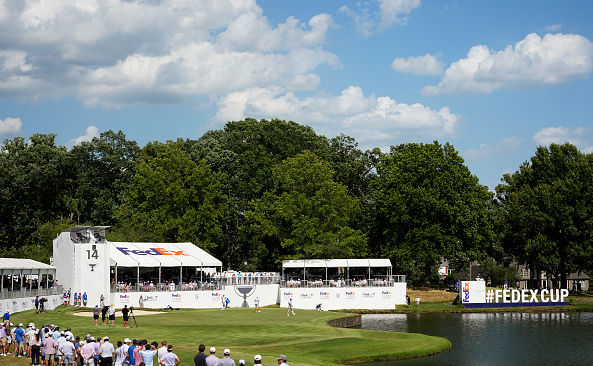
At some point, someone inside PGA Tour headquarters looked at a calendar, looked at a map of the United States and apparently decided this was the ideal way to determine a season champion:
Memphis. St. Louis. Atlanta. August.
Three consecutive postseason events. Three cities below the Mason-Dixon Line. Three places where late-summer heat and humidity can turn an afternoon round of golf into an endurance test.
Who thought this was a good idea?
The PGA Tour has spent years trying to transform the FedExCup Playoffs into golf’s version of a major American postseason — a compact, escalating three-week sprint designed to showcase its best players at the end of the season.
Instead, the 2026 version has another defining characteristic:
Heat.
The postseason begins at the FedEx St. Jude Championship in Memphis, moves to the BMW Championship in the St. Louis area and concludes with the Tour Championship in Atlanta.
And it’s August.
If anyone needed an illustration of the problem, Sunday in Memphis provided one.
As temperatures soared toward 100 degrees and Scottie Scheffler began building his lead, the tournament increasingly appeared less like the opening round of a high-stakes postseason and more like something everyone simply wanted to finish.
The energy seemed to drain out of the golf course.
Scheffler was doing what Scheffler does, methodically separating himself from the field. But behind him, many of the players appeared to be going through the motions. There was little sense of urgency, little electricity and increasingly little drama.
Players looked exhausted.
Spectators sought whatever shade they could find.
The combination of oppressive heat and a runaway leader sucked much of the life out of what was supposed to be the opening Sunday of the PGA Tour’s showcase postseason.
That isn’t necessarily a criticism of the players.
Put elite athletes outside for four-plus hours in near-100-degree temperatures after an entire week of competition — and after a long season that began months earlier — and fatigue is inevitable.
This isn’t just about player comfort
Professional golfers will survive.
They have trainers, hydration, cooling towels, shaded facilities and air-conditioned courtesy cars. It’s hardly coal mining.
The bigger question is why a supposedly fan-focused sports league would intentionally stage its three most important consecutive events in climates where simply walking the golf course can become unpleasant.
A golf tournament isn’t a three-hour football game inside a stadium. Spectators walk miles. They stand in direct sunlight. They wait at ropes and grandstands. They arrive hours before the leaders tee off and often remain until early evening.
Now ask them to do it in Memphis when the thermometer is flirting with 100.
Then St. Louis.
Then Atlanta.
The PGA Tour frequently talks about improving the fan experience. Here’s an easy place to start:
Don’t make attending your postseason feel like a heat-survival challenge.
There are competitive and entertainment considerations, too.
Extreme heat can affect course conditions, agronomy and firmness. Thunderstorms become a constant scheduling threat. More importantly, the conditions can simply sap energy from an event. Golf needs atmosphere, particularly on television. It needs galleries moving around the property, players engaged and a sense that something important is happening.
Sunday in Memphis demonstrated what happens when the environment works against all of that.
And none of this was unavoidable.
America is a very large country
That’s what makes the scheduling particularly strange.
The PGA Tour isn’t geographically trapped.
There are world-class golf markets throughout the northern United States that are actually enjoyable in August: New England, New York, Pennsylvania, Michigan, Wisconsin, Minnesota, Colorado, the Pacific Northwest and Northern California.
Instead of chasing 75-degree afternoons, the Tour’s postseason is chasing heat advisories.
Imagine a playoff rotation that begins somewhere in the Northeast, moves through the Great Lakes or Mountain West and finishes on the West Coast. Beyond providing more comfortable conditions, it could create something the FedExCup Playoffs desperately need: An identity.
The NFL has January.
Major League Baseball owns October.
College basketball owns March.
The PGA Tour could make August its traveling national championship — rotating through America’s greatest summer golf markets and courses.
Rotate the championship. Use iconic venues. Create scarcity. Let different regions host the finale. And, whenever possible, put players and fans somewhere they actually want to spend five hours outdoors.
Instead, the current itinerary feels less like a postseason designed from scratch than one assembled around existing sponsorship agreements and tournament relationships.


