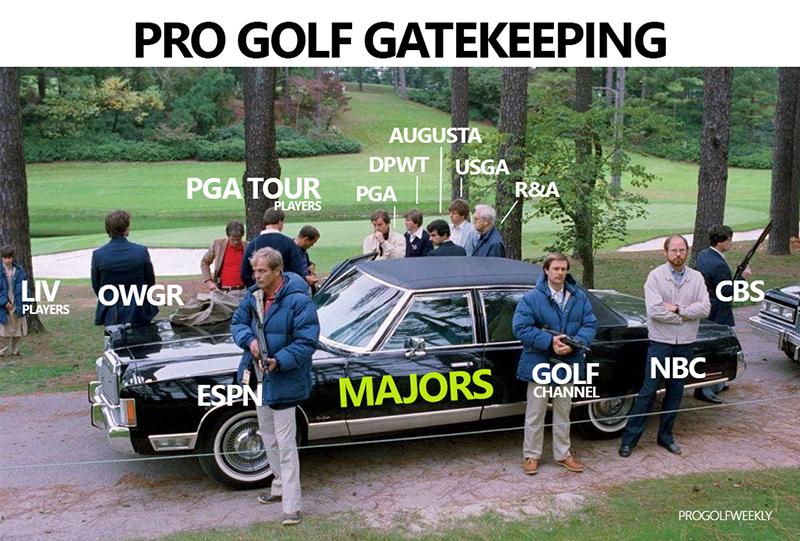

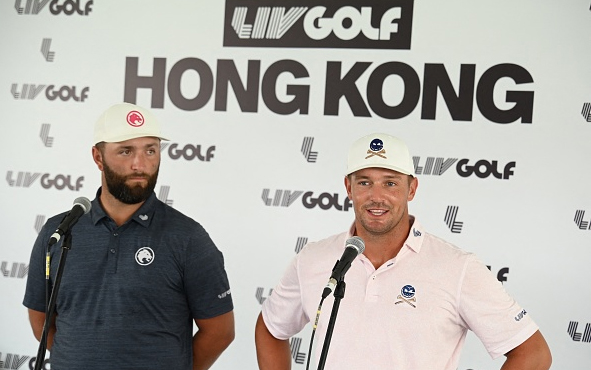
Once again, the establishment golf media couldn’t resist writing LIV Golf’s obituary — only to watch the league tee off right on schedule in Mexico City today.
Headlines blared “imminent shutdown,” “on the precipice of collapse,” and “bombshell announcement” that might cancel the very next event. Prominent pundits and self-styled reporters gleefully speculated that the Mexico tournament—the sixth stop of the 2026 season—might not even happen.
The snark-filled frenzy was fueled by unverified chatter from golf blogger Ryan French of Monday Q Info, who claimed players and employees hadn’t been paid, bills were unpaid, and a “bombshell” loomed.
Ive heard from multiple sources that a bombshell announcement on LIVs future is imminent.
We don't give out gambling advice but If your’re a prediction market type person I would bet the under of whatever they have posted.
— Monday Q Info (@acaseofthegolf1) April 15, 2026
The Telegraph, known mostly as a publisher of fake political news, piled on with tales of an “emergency meeting” in New York pulling executives away from the venue.
The golf twitter/X aggregation account NUCLR — popular for memes and video slop, gave it a boost of serious oxygen. More credible outlets, from Golf Channel to USA Today to Golf Digest, then ran with the narrative, treating rumor as near-fact.
🚨👀⛳️ #BREAKING — LIV Golf executives have been summoned to NYC for an emergency meeting, amidst reporting that the league’s future is in question. Players are reportedly “in the dark” over the future and the meeting has nothing to do with a potential DP World Tour merger,… pic.twitter.com/PMESIRaIGs
— NUCLR GOLF (@NUCLRGOLF) April 15, 2026
Golf Channel’s Rich Lerner even posted a Kalshi survey, suggesting LIV would close up shop before teeing off in Mexico. Lerner is one of the most respected voices in golf media.
Then came the cold slap of reality. LIV Golf CEO Scott O’Neil fired off a memo to players and staff: “I want to be crystal clear: Our season continues exactly as planned, uninterrupted and at full throttle.” Pairings were released. The event in Mexico City proceeded without a hitch.
Letter from Scott O’Neil to LIV staff#livgolf pic.twitter.com/ssPPhNDZxy
— Par and Paddock (@parandpaddock) April 15, 2026
Sergio Garcia, Fireballs GC captain, dismissed the noise: players had heard nothing contradicting what PIF Governor Yasir Al-Rumayyan had already assured them earlier in the year.
Fox News’ Bret Baier provided the key context the rumor mill conveniently ignored: while the Public Investment Fund (PIF) is shifting priorities and looking to divest after this season as part of its new 2026-2030 strategy, LIV Golf remains fully funded through the end of 2026. A fresh $266 million injection had already kicked off the year, bringing the cumulative PIF investment to over $5.3 billion.
Now from Bret Baier: Says Saudi Arabia’s funding of LIV “will definitely come to an end at the end of this LIV season, citing a change of priorities.” pic.twitter.com/rv88XQqd14
— Josh Carpenter (@JoshACarpenter) April 16, 2026
No immediate collapse. No canceled events. Just another round of premature eulogies from a media ecosystem that has been trying to bury LIV since 2022.
The sharpest knives came from the usual suspects. Golf Channel’s Brandel Chamblee, a one-time PGA Tour winner, jumped on French’s “bombshell” and declared LIV “so ill-conceived” that its shotgun starts, format tweaks, and supposed low viewership made a Saudi “euthanasia” unsurprising. He and others framed the rumors as confirmation of a “lame-brained tour” that was always destined to fail. This wasn’t cautious reporting; it was open celebration dressed as analysis.
This reflexive sanctimonious glee exposes a deeper rot in the establishment golf press. For years, many of these outlets and voices have operated as de facto defenders of the PGA Tour status quo. They downplayed the Tour’s own financial strains (eventually requiring a $1.5 Billion investment) and antitrust headaches while portraying LIV as an illegitimate, sport-killing interloper funded by “blood money.”
Every negotiation stall, every player movement, every dip in momentum became “proof” that the breakaway league was doomed. They were the real-life avatar of the “why would X do that” meme.

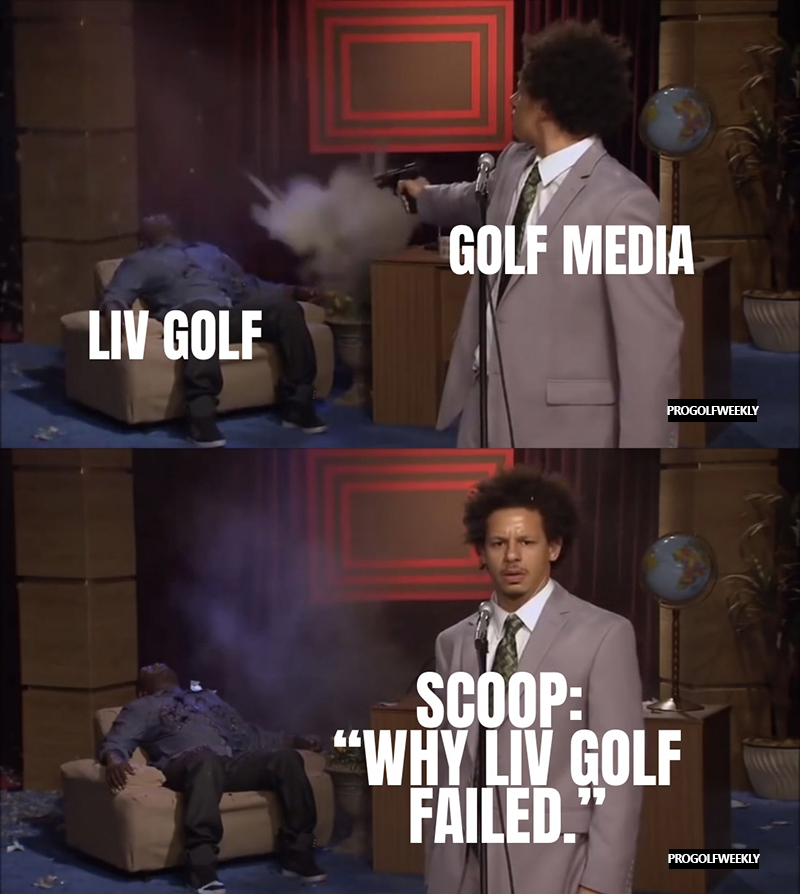
The pattern is now cartoonish: amplify unconfirmed whispers from social media, rush to publish dire headlines for clicks, then quietly move on when the sky doesn’t fall. They cried wolf so often that their credibility is in tatters. When actual long-term questions about post-2026 funding arise, the public will have every reason to tune them out.
What the critics conveniently ignore is basic business reality. They obsess over how much money the PIF has “burned” to launch and sustain LIV — now exceeding $5.3 billion with projections to top $6 billion by year’s end — but never acknowledge that this is how ambitious startups work, especially when challenging an entrenched monopoly like the PGA Tour.
“While this may seem counterintuitive, it’s a common strategy for achieving market dominance and long-term profitability,” writes Shobit Kohli, publisher of The Art of Startup Leadership newsletter.
Look at what LIV has endured: player suspensions, initial denial of TV deals, limited sponsorships, repeated battles for Official World Golf Ranking points (finally granted in 2026, albeit with heavy restrictions that award points only to the top 10 finishers), and restricted access to majors. All while building from scratch against institutional resistance that no traditional startup would face.
And yet, LIV fields a roster packed with marquee names, multiple major winners, and arguably two of the current five best players in the world. Now imagine a hypothetical startup league with modest funding and no real stars: it would have died in the planning stages, crushed before ever teeing off. LIV’s ability to not only survive but force the PGA Tour to adopt higher purses, no-cut events, and even introduce team play (via TGL) demonstrates resilience, not failure.
LIV has teed it up for every scheduled event since launching. It has paid out massive prize money, attracted major champions, earned partial OWGR recognition after shifting to 72-hole events in 2026, and disrupted a complacent ecosystem. The league’s model clearly rattled the old guard, which is precisely why the backlash has been so visceral and the reporting so sloppy.
🎯. I’ve spent the last 3-4 years talking to people throughout the world about golf. “American smugness” is a term that has come up frequently. It’s 🇺🇸 country club culture. Entitlement.
LIV has been revolutionary in terms of galvanizing that sentiment. pic.twitter.com/e5WDPcC40c— Pro Golf Critic (@ProGolfCritic) April 16, 2026
A post by ProGolfCritic, accompanied by a video from Ben Karpinski, perfectly captures the ecosystem which LIV disrupted: an entitled “country club bro” culture of American golf gatekeepers which many outsiders perceive as smugness personfied.
Golf fans deserve rigorous scrutiny of all parties, not advocacy disguised as journalism. They deserve reporters who verify claims before declaring a league dead, especially when executives are already on the ground at the venue and a simple memo sets the record straight.
The Mexico City leaderboard will take shape later today, exactly as planned. A winner will be crowned on Sunday. The real collapse isn’t LIV — it’s the credibility of the establishment golf media that once again chose slop over facts.
The league isn’t folding this season. The pundits who spent 48 hours dancing on its grave, however, just handed their audiences another reason to question everything they say and write.