

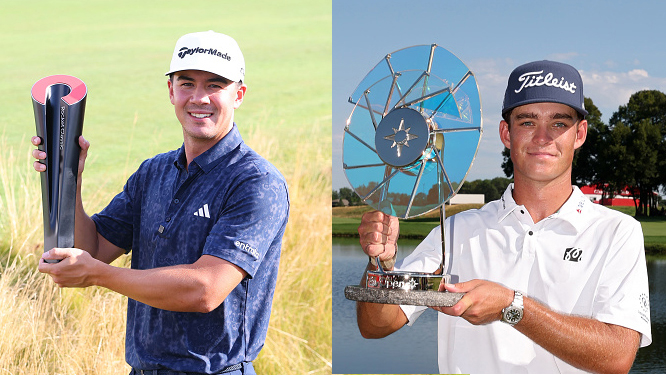
Back-to-back victories by Michael Thorbjornsen and Jackson Koivun are the first by players 24 or younger in nearly a decade. But history suggests replacing golf’s “Tiger Generation” won’t be easy.
For the first time since 2017, the PGA Tour has crowned consecutive champions aged 24 or younger.
Twenty-four-year-old Michael Thorbjornsen broke through with his maiden PGA Tour victory at the Rocket Classic after 21-year-old Jackson Koivun claimed victory a week earlier at the 3M Open.
On the surface, it’s merely an interesting statistical footnote.
Viewed through a wider historical lens, however, it raises perhaps the biggest long-term question facing professional golf: Is the long-awaited youth movement finally arriving, or is this simply a brief interruption in an era still owned by the Tiger Generation?
Nine Years Between Back-to-Back Young Winners


The previous occurrence came nearly nine years ago when two then-23-year-olds won consecutive events in July 2017:
- Xander Schauffele at The Greenbrier
- Bryson DeChambeau at the John Deere Classic
Neither player was viewed as a truly generational superstar at the time.
Today, both own multiple major championships and have become defining figures of modern golf.

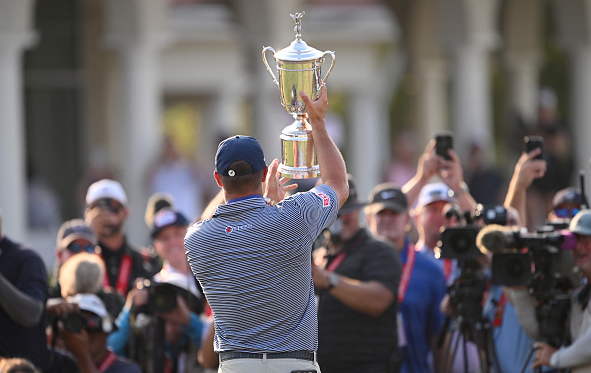
More importantly, they became cornerstones of what has evolved into arguably the greatest generation of golfers the sport has ever produced.
The Tiger Generation’s Unprecedented Run
Golf has always experienced cycles. Arnold Palmer passed the torch to Jack Nicklaus, who gave way to Tom Watson, quickly followed by a generation of international stars like Seve Ballesteros, Greg Norman and Nick Faldo. Then came the generation of Phil Mickelson and Ernie Els, among others.


Tiger Woods eventually reshaped the sport himself. He created his own generation.
And few generations have controlled professional golf as completely as the group born roughly between 1990 and 1997 — the so-called “Tiger Generation.”
Consider a partial roll call of just major winners:
- 5 – Brooks Koepka (1990)
- 4 – Scottie Scheffler (1996)
- 3 – Jordan Spieth (1993)
- 2 – Jon Rahm (1994)
- 2 – Collin Morikawa (1997)
- 2 – Xander Schauffele (1993)
- 2 – Bryson DeChambeau (1993)
- 2 – Justin Thomas (1993)
- 2 – Wyndham Clark (1993)
- 1 – Hideki Matsuyama (1992)
- 1 – Matt Fitzpatrick (1994)
- 1 – Patrick Reed (1990)
- 1 – Cameron Smith (1993)
This list doesn’t even include two of the most recent major winners: Aaron Rai (1995) and J.J. Spaun (1990). Not to mention Ryder Cup stars like Tyrrell Hatton (1991), Patrick Cantlay (1992), Sam Burns (1996), Tommy Fleetwood (1991), Viktor Hovland (1997), Cameron Young (1997), and Ben Griffin (1996), among others.
Collectively, they’ve won over 30 major championships and hundreds of worldwide titles, while becoming Ryder Cup legends and Olympians.


Instead of one or two dominant superstars, the era has produced an assembly line of elite Hall-of-Fame players. This generation became so dominant out of the gate that they even changed the career trajectory of Rory McIlroy, who’d won four majors before this generation took hold. After winning two majors in 2014 — his third and fourth, a young McIlroy was being mentioned in the same breath as Tiger and Jack.
Once this generation did get going, though, starting with Spieth in 2015, it was lights-out on McIlroy’s projected major victories hitting double digits. Rory was simply no match for a prime Spieth, Koepka, Xander, Bryson, Rahm, JT, and Scottie, among others. Ironically, he finally broke through again once this this generation aged a little, got injured, became rich, changed tours, married, and or welcomed children, among a myriad of real-life issues.
2011-14: Before Tiger Generation: Rory Wins 4 Majors
2015-24: 10-year Prime of Tiger Generation: Rory Wins 0 Majors
But perhaps their greatest accomplishment has been something even less obvious: they never really allowed the next generation to break through.
Get this: when the Masters kicks off the 2027 major season, there won’t be a single player under 30 who can call himself a major champion. Just an absolutely wild stat to think about. Has this ever happened before in golf history? No.
A Decade Without a True Youth Wave
In many sports, every few years brings a changing of the guard. Golf hasn’t worked that way recently.
Young players have certainly emerged. Ludvig Aberg immediately became elite. Nick Dunlap won twice before turning 21 but has fallen off the map since.
Tom Kim enjoyed enormous early success. Akshay Bhatia continues to shine here and there.
But collectively, the under-25 crowd has struggled to consistently displace the established stars.


Week after week, tournament after tournament, it has largely remained Scheffler, Schauffele, Morikawa, JT, Rahm, Bryson, Koepka and their peers collecting the biggest trophies and headlines.
The Tiger Generation has essentially extended its own youth.
The oldest, such as Patrick Reed and Brooks Koepka, are now 36.
Next year, the youngest members of that generation — Morikawa, Hovland, and Young — will turn 30.
For the first time, the group is no longer viewed as golf’s “young stars.”
They’re becoming the establishment.
Historically, this is exactly when younger challengers begin arriving.
But Context Matters
There is another side to the story: neither the Rocket Classic nor the 3M Open featured what would be considered a strong field.
Many of golf’s biggest names skipped both events. The deepest concentration of Tiger Generation stars opted for rest.
That naturally tempers the excitement.
Winning on the PGA Tour is extraordinarily difficult regardless of field strength, but it’s fair to ask whether these victories would have happened against the full collection of the superstars all competing simultaneously.
One hot weekend doesn’t necessarily represent a changing of the guard.
Golf’s Aging Curve is Changing
There’s another reason patience is warranted. Modern professional golfers simply stay elite longer.


Advances in fitness.
Sports science.
Nutrition.
Equipment.
Data analytics.
Travel management.
Recovery.
Players now routinely perform at world-class levels well into their late 30s and, in some cases, increasingly beyond (see Justin Rose and Adam Scott, or even recent Open Championship winner Ryan Fox).
If anything, today’s stars may enjoy longer primes than previous generations.

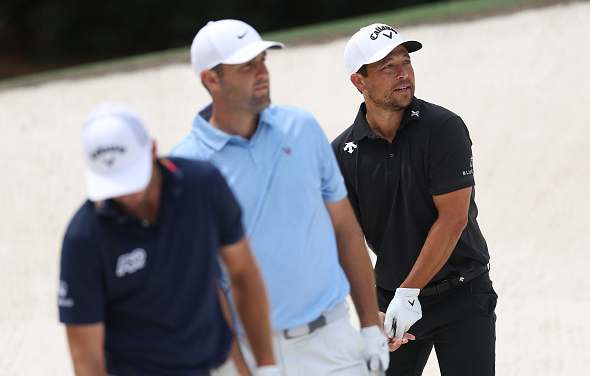
Scheffler turning 30 last month doesn’t mean he’s entering the back nine of his career. It may mean he’s just entering its middle stretch.
The same could be true for Morikawa, Rahm, DeChambeau, Schauffele and much of their generation.
Instead of fading over the next three or four years, they could realistically remain dominant well into the 2030s.
The Challenge Facing Koivun and Thorbjornsen
That’s what makes the road ahead so fascinating. Winning once announces your arrival.

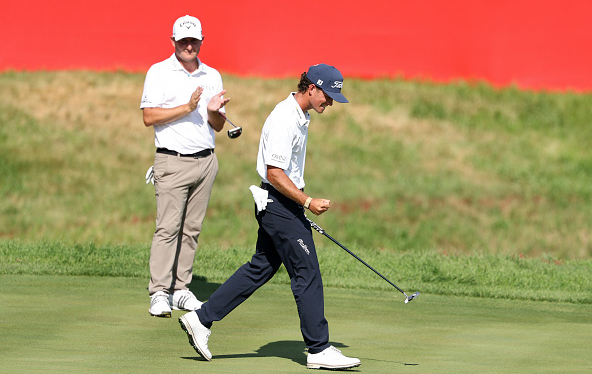
Winning repeatedly changes the narrtive.
Schauffele and DeChambeau proved that after their back-to-back victories in 2017.
Whether Koivun and Thorbjornsen become the faces of the next era — or simply two talented players who capitalized during weeks with thinner fields — will only be answered over the next couple of seasons.
Can they contend at major championships?
Can they win Signature events?
Can they consistently beat Scheffler, Morikawa, Schauffele and the rest when everyone is present?
That’s a far different test.
The verdict: Encouraging, but far from conclusive.