


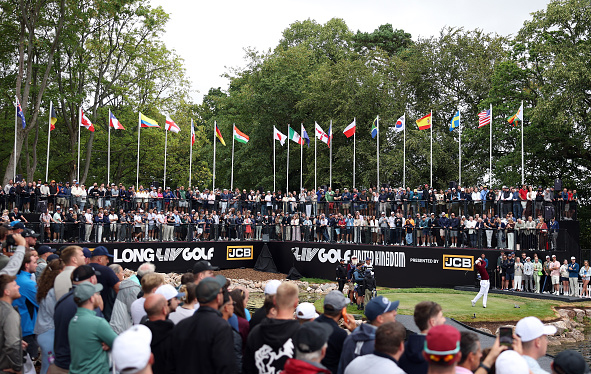
LIV Golf entered Chapter 11 in New Jersey on Tuesday. That sentence will be written as a tombstone in much of the coverage.
It is more useful to treat it as what the filing actually is: a court-supervised reorganization meant to keep the league operating while it sheds an unsustainable first-generation balance sheet and tries to stand up a smaller, player-aligned second act.
Chapter 11 is not liquidation. The company is not asking a court to wind it down.
It is asking for time, a stay on creditor actions, and a framework to recapitalize.
LIV’s own statement framed the move as “strategic action to secure its next era,” with a Restructuring Support Agreement already in hand with BC Partners Credit and a stated goal of emerging in early 2027.
The numbers are large because the original model was large. Trying to take on a monopoly is expensive.
Public Investment Fund equity into the LIV complex ran into the billions. After PIF said in April that further long-term funding no longer fit its strategy, the 2026 season was finished on a secured loan rather than a blank check.
The petition lists assets in the $100–500 million range and liabilities in the $500 million–$1 billion range. That gap is why a reorganization was available, and why it was used.
What the gloom-and-doom loop tends to skip is the other side of the ledger. Filings and subsequent reporting indicate 2025 revenue north of $200 million, with sponsorships about half of that and a reported $300 million in long-term sponsorship commitments for 2027–29.
There are also substantial U.S. net operating loss carryforwards that a reorganized entity could, if the plan holds, put to work against future taxable income. Those are not proofs of an easy future. They are reasons a professional investor would even look at the file.
The proposed structure is the most interesting part of the story, and the part least served by “LIV is dead” headlines.
The company says the reorganized league is intended to be majority owned by players, with BC Partners and possible minority investors providing exit financing after court approval. PIF is not walking away in the middle of the case; it has agreed to provide $49.6 million in debtor-in-possession financing, subject to the court, to fund the process.
That is a controlled handoff, not a fire sale in the dark.
The first hearing underscored that framing. Counsel told Judge Michael B. Kaplan the debtors did not arrive in “free fall,” cited committed revenue and remaining assets, and obtained initial approvals for case administration and financing mechanics.
That is the ordinary first day of a planned Chapter 11, not the last day of a failed experiment.
None of this makes success automatic. The BC Partners term sheet reportedly requires a requisite group of players to sign onto the new model on a short clock.
Players sit among the largest unsecured creditors; Jon Rahm ($7.5 million), Bryson DeChambeau ($5.7 million), Dustin Johnson ($5.5 million), Cameron Smith ($4.8 million), Tyrrell Hatton ($3.4 million) and Brooks Koepka ($1.7 million). Those figures appear to reflect unpaid current-period amounts rather than the full historic contract stack.
Vendors are owed money. Staff has already been cut. A leaner 2027 calendar — discussed in some reports as closer to 10 events than 14 — would be a different product than the original splash tour.
Those are real constraints.
They are also the constraints of a startup that spent four years buying attention, talent, and format experiments at a price no commercial sports league can carry forever.
The first era proved that team golf, shotgun starts, and guaranteed purses could attract major winners and a distinct audience. It did not prove that the same cost structure could live without a sovereign backer.
Chapter 11 is how American companies try to keep the product and lose the cost structure.
If LIV 2.0 works, it will look less like a disruption funded from Riyadh and more like a niche circuit with player equity, private credit, and a calendar sized to actual ticket, sponsor, and media demand.
That is a less romantic story than either “golf’s revolution” or “golf’s collapse.” It is also the only story the court file currently supports: not the end of the league, but an attempt to put it on a footing that can survive contact with a P&L.


