













The PGA Tour would very much like you to believe its playoffs have arrived.
The graphics say FedExCup Playoffs. The commercials say playoffs. The announcers repeatedly remind viewers that the season is now on the line. There are points projections flashing across the screen, players being “eliminated,” and a three-week march supposedly designed to crown golf’s champion.
There is just one problem:
None of it actually feels like the playoffs.
And if the 2026 FedEx St. Jude Championship was supposed to be the opening act for the PGA Tour’s postseason, it instead provided perhaps the best evidence yet that the entire concept desperately needs to be reimagined.
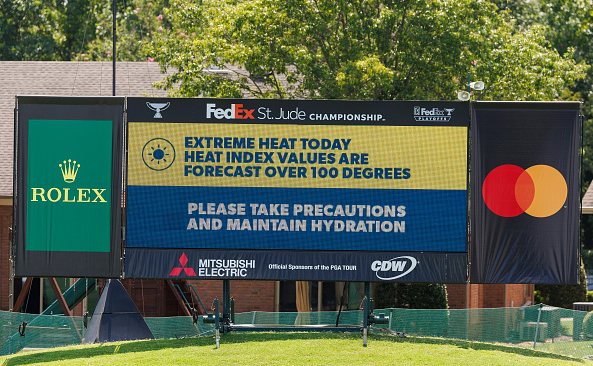
Memphis in August. Temperatures approaching 100 degrees. A golf course that looked increasingly cooked on television. Sparse galleries. Virtually no atmosphere. Players and spectators seemingly trying to survive the heat rather than generate postseason electricity.
Then Scottie Scheffler won by eight shots.
Some playoffs.
Scheffler deserves none of the criticism, of course. The World No. 1 did exactly what a superstar is supposed to do: he separated himself from the field and turned Sunday into a coronation. He finished 17-under and won by eight, collecting his 21st PGA Tour victory in dominant fashion.
But from an entertainment standpoint, it was precisely what the Tour did not need.
By the back nine Sunday there was no championship drama. There was no duel. There was no tension around who would win. The only manufactured suspense available came from watching projected FedExCup standings shuffle around near the No. 50 bubble.
That may appeal to the hardest of hardcore golf fans.
It is not exactly Chiefs-Bills in January.
Memphis in August. Whose Idea Was This?
Start with the most obvious problem.
Why is the PGA Tour deliberately staging the opening round of its supposedly marquee postseason in Memphis in the middle of August?
This was not merely a warm week.
The PGA Tour itself forecast highs near 100 degrees Saturday and 101 Sunday. The tournament leaderboard showed 97 degrees Sunday, while organizers spent the week preparing spectators for extreme heat.
This is supposed to be the Tour’s showcase postseason. Instead, players looked drained, spectators searched for whatever shade they could find, and everyone on property appeared to be rationing energy.
That matters.
Atmosphere in sports is created by the fans.
Crowds standing shoulder-to-shoulder.
Noise. Movement. Anticipation.
When it is approximately 100 degrees outside and the feels-like temperature is even more miserable, nobody wants to stand exposed beside a fairway for seven hours screaming after approach shots.
They want water and air conditioning.
So instead of a playoff atmosphere, television viewers got something that frequently looked and sounded like a sleepy regular-season tournament being played at the worst possible time of year.
TPC Southwind Doesn’t Exactly Scream Postseason
Then there is the visual presentation.
TPC Southwind has produced good tournaments over the years. It has history in Memphis, and the event’s longstanding connection with FedEx and St. Jude Children’s Research Hospital is significant.
But none of that means the course is an ideal television stage for a premier postseason event.
By Sunday, parts of the property looked beaten down by the brutal Tennessee summer. Brownish areas around greens and stressed turf do not exactly create the lush, pristine visual presentation one associates with a championship showcase.
And even when conditions are perfect, Southwind is hardly one of those venues that jumps through the television screen.
Augusta looks like Augusta.
Pebble Beach looks like Pebble Beach.
Riviera has an identity.
Even the best rotating BMW Championship venues tend to provide the visual impression of a major championship.
Southwind often looks like exactly what it historically was: a perfectly respectable longtime PGA Tour stop, hosting the ‘St Jude Classic’ in early June.
The Tour has simply moved it to August, replaced ‘Classic’ with ‘Championship,’ slapped the word ‘Playoffs’ onto it, and asked everyone to pretend it suddenly feels bigger.
It doesn’t.
Where Was Everybody?
The gallery shots hardly helped, particularly in the opening rounds.
This is supposedly the point in the season when interest should be peaking, yet much of the tournament lacked the enormous crowds and electric corridors that viewers associate with consequential sports.
Yes, the weather obviously played a role. Who could blame fans for not wanting to bake in triple-digit heat?
But that is precisely the point.
The PGA Tour chooses when and where these tournaments are played.
If the conditions suppress attendance, diminish crowd energy and make the players themselves look exhausted, that is a scheduling failure.
The postseason should be placed in locations and venues designed to maximize its importance.
Instead, the Tour seemingly backs into August dates at legacy sponsor venues and then tries to market whatever comes out the other side as must-see television.
Then CBS Got Preempted By 3-on-3 Basketball
Perhaps nothing captured the stature problem better than Saturday afternoon.
Golf fans waiting for CBS’s coverage discovered that the network’s scheduled BIG3 basketball programming had run long, pushing back the start of the golf broadcast.
Yes, the opening event of the PGA Tour Playoffs was waiting around for 3-on-3 summer scrimmage basketball.
You almost couldn’t script the symbolism any better.
Imagine an NFL playoff game broadcast being delayed because a pickleball game had not finished yet?
Imagine the NBA postseason getting bumped down the television hierarchy during a conference semifinal for bowling?
Yet the PGA Tour wants viewers to simultaneously accept that this is one of the biggest stretches of its season while its broadcast partner effectively says: We’ll get to you when this BIG3 contest is finished.
Nothing says major-league postseason quite like being trumped by three-on-three basketball in August.
The “Playoffs” Themselves Barely Function Like Playoffs
The larger problem is that the FedExCup postseason remains an awkward attempt to force a stick-and-ball playoff concept onto an individual sport.
The field started with the top 70 in FedExCup points and shrank to 50 after Memphis. Those 50 go to the BMW Championship, and then 30 advance to East Lake.
Fine. Except it’s not the top 50 on the scoreboards fans can follow. It’s the season-long points list.
So what exactly are viewers rooting for?
The tournament winner?
The season points leader?
Someone moving from 53rd to 40th?
Someone falling from 49th to 51st?
Someone already safely inside the top 30 who can finish near the bottom and proceed anyway?
Sungjae Im was the only player in Memphis who played his way from outside the top 50 into the BMW field, while Keith Mitchell was the player displaced. Matt McCarty finished the tournament T63 at 7-over par and still retained the final No. 50 position.
Think about that from the casual viewer’s perspective.
A player can finish near the bottom of the leaderboard in a “playoff” tournament and advance.
Another player can play substantially better and have his season end depending upon the points mathematics accumulated over the previous seven months.
That’s not a playoff in the way sports fans understand the term.
It’s a season-long points system with three additional golf tournaments attached to the end.
Where Was The Movement?
The Tour constantly promotes the “bubble” because it desperately needs something resembling elimination-game drama.
But Memphis hardly delivered chaos.
There wasn’t some mad Sunday afternoon scramble in which eight players charged into the next round and eight recognizable names crashed out.
There was essentially one exchange around the cutoff: Im moved in and Mitchell moved out.
Jordan Spieth provided one of the few recognizable elimination storylines, finishing T19 but ending the week 52nd in the FedExCup standings and missing the BMW Championship.
Otherwise?
Mostly projections.
Lots and lots of projections.
The PGA Tour has somehow created a playoff system where a significant portion of the drama requires a television graphic and an explanation from an announcer.
Great sports rarely require that much explaining.
Bottom of the ninth. Tie game. Bases loaded.
Fourth-and-goal.
Sudden-death hockey overtime.
One-point game, ten seconds left.
Everyone understands the stakes instantly.
Golf’s postseason equivalent is apparently:
“If Player X finishes T17 instead of T19, unless Player Y makes birdie at 16, he will move provisionally from 52nd to 49th.”
Feel the excitement.
And The Actual Tournament Became a Rout
Scheffler’s brilliance then removed whatever championship suspense remained.
He entered Sunday with a two-shot lead and ultimately won by eight. He moved from first to, well, first.
Again, that’s not Scheffler’s problem.
Dominance is part of sports, and watching the best player in the world dismantle a field can itself be compelling.
But combined with everything else — oppressive heat, subdued galleries, an uninspiring television canvas and limited FedExCup movement — the final round became almost funereal.
There was little sense of urgency.
Little buzz.
Little noise.
Little drama.
Players seemed to be going through the motions as Scheffler disappeared into the distance and temperatures soared.
This was supposedly Game 1 of the PGA Tour postseason.
It felt closer to a late-August contractual obligation.
The PGA Tour Needs To Decide What The FedExCup Is
This has been the fundamental problem with the FedExCup since its creation.
The PGA Tour desperately wants its own version of the playoffs because American sports culture understands and embraces playoffs.
But professional golf isn’t football.
You cannot simply appropriate the terminology and expect the emotional dynamics to follow.
Calling something a playoff does not make it one.
If the Tour wants a genuine postseason, then create one.
Make advancement overwhelmingly dependent upon what players do that week.
Create real elimination.
Produce dramatic volatility.
Play championship-caliber venues in climates conducive to huge crowds and premium conditions.
Build the television schedule around the events rather than appeasing sponsors.
Make reaching Sunday feel consequential.
And above all, make the system simple enough that somebody tuning in for the first time immediately understands what is at stake.
Because what happened in Memphis this week wasn’t it.
That wasn’t playoff golf.
That was a regular PGA Tour event being marketed as a playoff.