










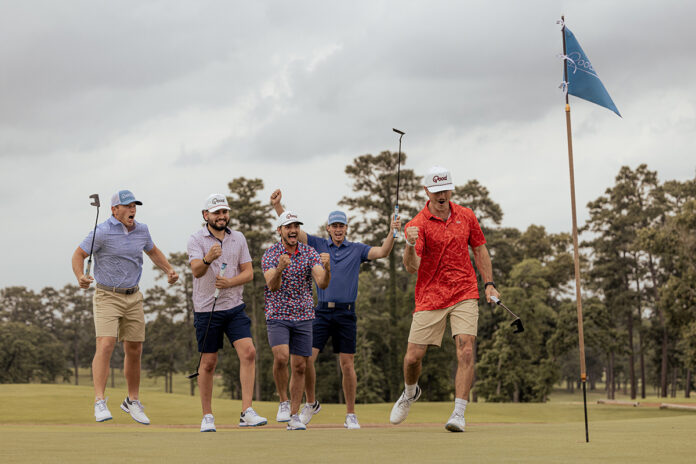
Good Good Golf deserved criticism for a clumsy, ill-conceived advertisement. What happened next — lost sponsors, canceled television, disappearing retail space and an executive purge — looks increasingly less like accountability and more like an old-fashioned corporate-media pile-on.
Let me begin with what should be an important disclosure: I have never watched a single episode of Good Good Golf.
Not one.
I have no emotional attachment to the group, no history defending them and no particular reason to protect their brand. In fact, before the last two weeks, my prevailing thought about Good Good was almost the opposite. I never completely understood how the brand became as large as it did.
More than two million YouTube subscribers. Major equipment partnerships. Merchandise filling national retailers. A PGA Tour tournament carrying its name. A Golf Channel television series.
It always seemed a little overblown to me.
Then again, I’m in my mid-late 40s and YouTube golf isn’t exactly my natural habitat.
Which is precisely why my reaction to the Good Good controversy surprised even me.
I find myself defending them.
Or, more accurately, defending some sense of proportionality.
Because whatever legitimate criticism Good Good deserved for producing one spectacularly stupid advertisement, what followed has become absolutely nuts.
The controversy began with a 60-second promotional video for a Good Good-branded Callaway driver. The concept was intended as a parody of the 2026 horror movie Obsession. In the scene that quickly went viral, Good Good co-founder Garrett Clark runs toward fellow Good Good member Alexis Miestowski as she reaches for his driver, pushes her to the ground and warns her not to touch the club.
Was it funny?
Apparently not.
Was it clever?
Definitely not.
Was it tone-deaf and poorly executed?
Sure.
But somewhere along the way, an awful attempt at comedy was rhetorically transformed into something approaching an actual act of violence against women.
That distinction matters.
Miestowski wasn’t an unsuspecting woman attacked on a sidewalk. She wasn’t filing a police report. Clark wasn’t arrested. There was no allegation that an actual assault occurred.
She is herself a Good Good member and participant in a scripted comedy bit.
Those facts don’t magically make the video tasteful. They do, however, provide context.
And context disappeared remarkably quickly.
Where Was the Alleged Victim?
One aspect of the coverage struck me as particularly strange from the beginning.
Where was Alexis Miestowski?
The entire scandal was being discussed through the language of violence against women, yet the woman actually appearing in the video seemed oddly peripheral to much of the national coverage.
Reporters routinely seek out the person supposedly harmed in a controversy. Her perspective would seem especially relevant here.
Was she offended by the concept? Did she object during filming? Did she believe the scene trivialized domestic violence? Did she regret participating? Did she feel exploited?
Or did she simply believe she was acting in a stupid movie parody with her coworkers?
Those aren’t minor questions. They go directly to what actually happened.
Instead, the narrative raced ahead.
Within days, Good Good had become toxic.
Callaway severed a partnership that began in 2023. Good Good withdrew as title sponsor of the PGA Tour’s November event in Austin. Golf Channel canceled the planned season of Big Break x Good Good. Dick’s Sporting Goods, Golf Galaxy, PGA Tour Superstore and Target removed merchandise.
And then came the personnel casualties.
Good Good’s vice president of brand and marketing was fired. Callaway’s director of content and production departed. Days later, Good Good CEO Matt Kendrick and president Joe Flannery were gone as well.
A six-year-old brand had gone from ascending golf-industry darling to radioactive material in roughly a week.
Over a bad commercial.
That’s where my skepticism kicked in.
The Punishment Kept Growing
Good Good apologized almost immediately.
Then it apologized again.
Garrett Clark apologized personally and called the ad a terrible idea. Callaway apologized. Callaway acknowledged something especially important: it had approved the advertisement before it was posted.
Ordinarily, that would be somewhere near the end of a controversy like this.
Delete the video.
Admit it was stupid.
Apologize.
Maybe donate money to an appropriate organization.
Review whatever approval process produced the mess.
Move on.
Instead, every apology seemed to produce another demand for punishment.
Callaway eventually ended the relationship and pledged $1 million to organizations addressing violence against women. Good Good lost its PGA Tour sponsorship. Retailers stripped merchandise from shelves. Golf Channel effectively buried a completed television product. Executives began losing their jobs.
The original offense didn’t change.
Only the consequences did.
At some point, accountability crossed into annihilation.
Then Brian Rolapp Stepped In
PGA Tour CEO Brian Rolapp added another layer when he publicly chastised Good Good during his Tour Championship press conference.
“What we saw was concerning,” Rolapp said, calling it “clearly not aligned with PGA TOUR values.” He said Good Good’s original response was “disappointing,” “a bit defensive and late,” while acknowledging that subsequent responses were improving.
That’s a remarkable public dressing-down of a business partner over a fictional skit.
It also struck me as more than a little rich coming from Rolapp.
Before arriving at the PGA Tour, Rolapp spent decades at the NFL, ultimately serving as one of its most powerful executives. The NFL has dealt repeatedly with very real domestic-violence cases involving players — police investigations, arrests, suspensions and criminal allegations.
There is an obvious difference between responding forcefully to actual violence and responding to actors performing a tasteless fictional scene.
Yet Good Good was being discussed in institutional language that seemed to blur that difference.
I have four daughters and have been married for 24 years. I’m hardly looking for reasons to minimize violence against women. Real domestic violence is horrifying precisely because it is real.
That is part of why casually equating a staged movie parody with the real thing bothers me.
Words should retain meaning.
The Curious Part
None of this proves that there was some grand, organized plot against Good Good.
There is no public evidence establishing that.
But you also don’t need a conspiracy theory to notice when incentives suddenly align.
The speed and uniformity were extraordinary.
Golf media outlets began hammering the story. Industry partners began distancing themselves. Retailers reacted. Golf Channel reacted. The PGA Tour reacted. Callaway — which had itself approved and reposted the advertisement — eventually severed the relationship.
Front Office Sports seemed to chronicle one development after another as if it were a modern-day Watergate, including employee departures, while Sports Business Journal and other establishment news outlets tracked the expanding fallout.
The effect was a self-reinforcing scandal.
One company distancing itself became news.
That news increased pressure on the next company.
The next company distancing itself created another headline.
That headline justified another response.
And suddenly the question was no longer whether Good Good had made an offensive advertisement.
It was which organization would be next to publicly condemn them.
That’s how a controversy becomes what I call a doom loop.
It doesn’t require people secretly sitting around a conference table plotting someone’s destruction. Modern corporate cancellation campaigns can practically coordinate themselves.
Media pressure creates corporate pressure.
Corporate action creates more media coverage.
More media coverage creates social pressure.
Social pressure gives other corporations an incentive to demonstrate that they, too, are on the correct side.
Round and round it goes.
Callaway’s Role Makes the Story Even Stranger
Perhaps the most important fact in this entire controversy is that Good Good wasn’t acting alone.
Callaway approved the advertisement.
Its CEO subsequently admitted as much.
That should have complicated the simplistic villain narrative considerably.
Good Good’s then-CEO certainly thought it did.
After Callaway ended the relationship, Kendrick publicly accused the equipment company of approving the ad and then asking Good Good to “take the fall,” even alleging a “coordinated media blitz.”
That was Kendrick’s allegation, not an established fact.
But it does highlight the uncomfortable question at the center of the controversy:
If two business partners approved a bad piece of creative together, why did one suddenly emerge as something approaching a corporate pariah?
Callaway was rightly criticized. It apologized. It donated money.
Good Good seemingly received the corporate death penalty.
Has Anyone Asked Whether the Punishment Fits the Crime?
That question seems almost quaint now.
Proportionality used to matter.
A poorly executed commercial can deserve condemnation without requiring the destruction of the company that made it.
Two things can simultaneously be true:
Good Good produced an idiotic advertisement.
And the subsequent reaction can be wildly disproportionate.
Those positions aren’t contradictory.
The bizarre thing about modern outrage culture is that once a controversy reaches critical mass, saying “this punishment seems excessive” gets interpreted as defending the original behavior.
It isn’t.
I don’t think the video was good.
I don’t think pushing a woman to the ground was a particularly intelligent visual gag.
I also don’t think a scripted movie parody involving two consenting coworkers should result in a company losing an equipment partner, a PGA Tour tournament, national retail distribution, a television program and multiple senior executives.
Apparently that’s now the radical position.
Six Years to Build. Days to Torch.
This may ultimately become the most interesting business lesson from the entire Good Good affair.
The company spent roughly six years building an audience powerful enough to disrupt the traditional golf-media ecosystem.
It converted YouTube viewers into customers.
It converted customers into retail leverage.
It converted digital credibility into relationships with Callaway, national retailers, Golf Channel and eventually the PGA Tour itself.
Then one badly conceived 60-second video threatened to unwind much of it in less than two weeks.
There is something deeply unhealthy about a corporate culture in which that outcome is considered normal.
And watching company after company sprint for daylight — while headline after headline chronicled the next cancellation — it became difficult not to wonder whether everyone was reacting to the original video anymore.
Or whether they were reacting to everyone else’s reaction.
That distinction matters.
Because when punishment becomes detached from the severity of the offense, the objective stops being correction.
It becomes purification.
And from where I sit — as someone who didn’t watch Good Good before this mess, didn’t particularly understand its popularity and had absolutely no reason to defend it — this stopped looking proportionate a long time ago.
It was a stupid video.
Delete it. Apologize. Learn from it.
But destroying a six-year-old brand over a botched movie parody?
That’s not accountability.
That’s a feeding frenzy.