











At some point, professional golf has to stop fighting the last war.
Apparently, nobody has bothered to tell the DP World Tour.
With LIV Golf transitioning toward its next chapter and nearly the entire sport facing an obvious opportunity to begin putting four-plus years of division behind it, one might expect the European circuit to sound something resembling conciliatory.
Instead, the message coming out of Wentworth this week sounded more like a victory lap mixed with an airing of grievances.
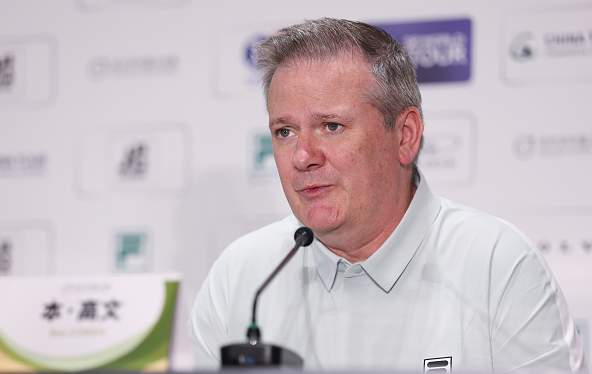
Ben “Coward” Cowen, DP World Tour’s chief tournament and operations officer, described the past five years as a “constant battle” with LIV Golf and rejected LIV CEO Scott O’Neil’s recent suggestion that the league wants to “complete, not compete” with golf’s established tours.
According to Cowen, who looks as pathetic as he sounds, LIV absolutely became a competitor.
“Without a doubt they were and are a competitor,” Cowen told Golf Digest, describing battles over tournaments, venues and commercial partners.
Fine. LIV competed with the DP World Tour.
That was sort of the point.
It launched as a rival professional golf product. It offered players substantially more money. It pursued sponsors, venues and markets. It attempted to build something that existed outside the PGA Tour-DP World Tour establishment.
Competition happened.
Welcome to business.
The bizarre part is hearing the DP World Tour still speak about this development as though LIV violated some sacred gentleman’s agreement requiring every ambitious golf organization on Earth to politely stay out of its way.
Professional golf desperately needs fewer grudges right now, not more of them.
The Tour Sponsored By Dubai Is Complaining About LIV’s Ambition
There is also an irony here that has become almost impossible to ignore.
This isn’t even officially called the “European Tour” anymore.
It is the DP World Tour, named after the Dubai-based logistics company owned by Dubai World, an investment company ultimately owned by the government of Dubai.
DP World has been involved with the European Tour since 2009, became title sponsor of its season finale in 2012 and took title sponsorship of the entire circuit beginning in 2022. Its agreement now runs through 2035.
In other words, one of professional golf’s most internationally financed tours is upset that another internationally financed tour entered the marketplace and competed internationally.
You really couldn’t script the irony much better.
This isn’t an argument that DP World’s sponsorship is improper. It isn’t.
It is an argument that perhaps a tour carrying the name of a major UAE-owned corporation should show a little self-awareness before assuming the role of aggrieved defender of golf’s old commercial order.
Especially when its complaint boils down largely to: They competed with us.
Yes.
They did.
Golf Needed Competition
For decades, professional golf operated inside an ecosystem with remarkably little disruptive competition.
The PGA Tour dominated elite American golf.
The European Tour existed largely as the world’s second major traditional circuit.
Players operated within that structure because there wasn’t much alternative.
Then LIV arrived with billions of dollars, enormous guaranteed contracts and a completely different economic model.
Suddenly players had leverage.
Suddenly tours had competition.
Suddenly prize funds increased.
Suddenly organizations that had spent decades dictating terms had to start selling players on why they should remain.
You don’t have to love everything about LIV Golf to acknowledge that competition forced professional golf’s incumbent organizations to move.
And competition isn’t supposed to be comfortable.
That’s why it’s competition.
The idea that LIV should somehow have created a rival global golf league without pursuing elite players, desirable venues, sponsors or broadcast partners is absurd.
What exactly was it supposed to compete with?
Imaginary tournaments?
The DP World Tour Wasn’t Merely An Innocent Bystander
There is another piece of revisionism creeping into the discussion.
The European circuit wasn’t sitting peacefully on the sidelines while the PGA Tour and LIV fought.
It chose a side.
The DP World Tour entered a strategic alliance with the PGA Tour, disciplined members who played LIV events and fought those players through arbitration.
Its former dimwit CEO Keith Pelley, who is now ruining the Toronto Maple Leafs, once publicly accused LIV players of choosing “money over competition” while defending the circuit’s disciplinary measures.
That was the DP World Tour’s prerogative.
But actions have consequences in both directions.
Once the European Tour effectively aligned itself strategically with LIV’s biggest competitor, why would LIV Golf be expected to treat the DP World Tour as some protected neutral party?
You cannot help construct a commercial alliance against a rival and then clutch your pearls because the rival competes against you.
Pick one.
And Now Everyone Needs Each Other
The strangest part of Cowan’s comments is that the golf world is finally entering a period in which reconciliation actually appears possible.
The DP World Tour itself granted conditional releases to eight LIV players for the 2026 season, allowing players including Tyrrell Hatton, Thomas Detry, Tom McKibbin, Adrian Meronk and David Puig to maintain membership after satisfying specified conditions.
That’s progress.
That’s what the sport needs more of.
Find compromises.
Create pathways.
Get great players back into tournaments together.
Stop forcing fans to understand suspensions, releases, fines, appeals, eligibility rules and which corporate faction currently recognizes which golfer.
There is an enormous opportunity here for the DP World Tour in particular.
Unlike the PGA Tour, it has always sold itself as Golf’s Global Tour. Its 2026 schedule features events across numerous countries, including three tournaments in Dubai alone.
That makes it uniquely positioned to become a bridge between golf’s competing factions.
It can welcome players from different ecosystems.
It can strengthen historic national opens.
It can leverage its international identity rather than behave like the PGA Tour’s resentful junior partner.
Instead, we’re still hearing about the war.
LIV Didn’t Invent The Problem
There is also a tendency throughout establishment golf to speak as though everything was perfectly healthy until LIV suddenly appeared and ruined the neighborhood.
It wasn’t.
The European Tour had already spent years watching many of its best players migrate toward America because that’s where the money, ranking points and biggest weekly opportunities increasingly existed.
That talent drain didn’t begin with Greg Norman.
The PGA Tour had effectively become the destination for Europe’s best golfers long before anybody hit a shot in a LIV tournament.
Yet somehow that dynamic was accepted as the natural order of professional golf.
When LIV began competing for those same players?
Suddenly competition itself became offensive.
That’s the part that has always been difficult to take seriously.
If losing players to a wealthier rival damages your product, then perhaps your fundamental problem isn’t that another league was willing to hire them.
Perhaps your problem is that you weren’t offering enough reasons for them to stay.
Enough With The Crying
Cowen may be entirely correct that LIV pursued DP World Tour venues, sponsors and commercial opportunities.
That’s what rival sports properties do.
Formula One competes for sponsors.
Soccer leagues compete for players.
Streaming platforms compete for rights.
College conferences compete for schools, television contracts and markets.
Businesses compete.
The response shouldn’t be five years of grievance.
It should be building a better product.
And now, after years of professional golf tearing itself apart, the objective should be even simpler:
Put the sport back together.
The DP World Tour has an opportunity to be instrumental in doing exactly that.
It can serve as neutral ground.
It can provide pathways between tours.
It can bring LIV players, PGA Tour players and Europe’s emerging talent together at historic events.
It can become more important in the new professional golf ecosystem than it has been in decades.
Or it can continue complaining that LIV Golf had the audacity to compete with it.
One path sounds like leadership.
The other sounds like a business discovering competition for the first time — and still whining about it five years later.
For a tour whose title sponsor comes from Dubai, the aggrieved act isn’t merely tired.
It’s becoming difficult not to laugh at.