
















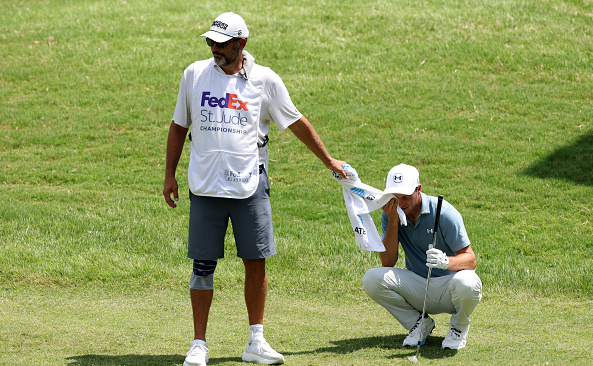
Jordan Spieth has spent much of the past eight years telling anyone willing to listen that his golf is better than the numbers suggest.
This week, he offered another version of the familiar refrain.
Spieth said he felt as though he was playing some of the “best golf in years, even if the scores weren’t necessarily showing it.”
And then, almost on cue, the scores showed it.
After an encouraging start (65, -5), Spieth followed with rounds of 69, 72 and 70 to finish at 4-under and tied for 20th. Respectable golf, certainly. But hardly the kind of week that matched the rhetoric — and, more importantly, nowhere near enough when Spieth desperately needed a big finish.
The result ended his PGA Tour postseason after one event. Spieth failed to climb inside the top 50 in the FedExCup standings, meaning he will not advance to the BMW Championship and the second leg of the playoffs for the third straight season.
There was another costly consequence: missing the top 50 also meant Spieth failed to lock up automatic access to the Tour’s lucrative Signature Events for 2027.
For a player insisting his game is approaching its best, those are difficult numbers to explain away.
The Spieth Cycle
This has become something of an annual tradition with Spieth.
Since roughly 2018, there has seemingly always been a reason to believe the breakthrough was right around the corner. The swing feels better. The ball-striking is improving. The underlying golf is stronger than the results indicate. The scores aren’t quite reflecting the quality of play.
At some point, though, the scoreboard gets a vote.
Spieth’s comments this week had the feel of Dorothy clicking her heels together and repeating, ‘There’s no place like 2015.’
That magical season remains the standard against which everything else is measured. Spieth won five times, captured the Masters and U.S. Open, finished one shot out of a playoff at the Open Championship and was runner-up at the PGA Championship. He’d go on to win the Tour Championship and claim the FedEx Cup trophy. In 2016, he famously collapsed at the Masters after leading by five strokes heading to the back-nine on Sunday. He bounced back to finish with two wins on the season. In 2017, he won three more, highlighted by a third major at the Open Championship.
Three majors and 11 PGA Tour wins BEFORE his 24th birthday. Spieth appeared positioned to dominate golf for the next decade.
Instead, the decade became something very different.
There have been flashes. There were a couple of wins. There have been stretches where Spieth genuinely looked close to rediscovering the player who once seemed inevitable.
But “close” has now lasted a very long time.
Eventually, Good Golf Has to Produce Good Scores
There is nothing particularly embarrassing about finishing T20 in a PGA Tour playoff event. In isolation, it is a perfectly solid result.
Context is what changes everything.
Spieth wasn’t entering the week safely inside the postseason. He needed to move. He needed points. He needed a performance substantial enough to extend his season and secure his position among the Tour’s top 50.
Instead, he produced three follow-up rounds of 69, 72 and 70 and went home.
The prediction almost wrote itself beforehand: here comes the inevitable pedestrian round followed by another weekend spent trying to turn supposedly excellent golf into an actual result.