











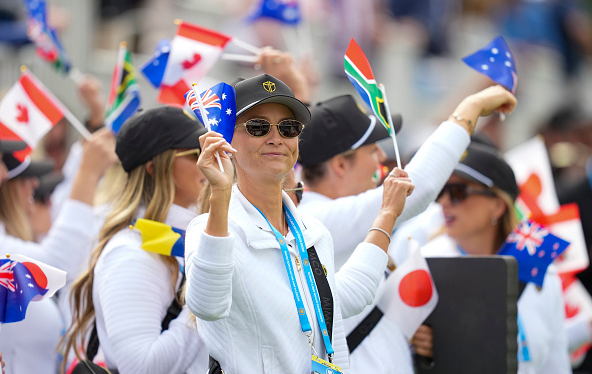
The Presidents Cup returns with perhaps the strangest geopolitical premise in sports:
The United States vs. virtually everybody on Earth who isn’t European.
That’s basically it.
The Ryder Cup, for all the jokes people can make about “Team Europe,” at least has an identifiable foundation. Europe has spent decades building institutions around a broader continental identity. There is a European Union. There is a European flag. There is even an anthem.
You can laugh at Brussels bureaucracy all you want, but the basic concept is understandable.
The Presidents Cup International Team?
Its motto might as well be: “Not American. Also not European.”
That’s the entire admissions policy.
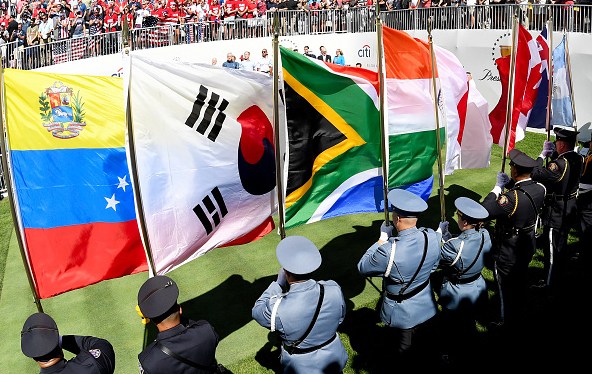
Canada? Welcome aboard.
Australia? International.
South Korea? International.
Japan? International.
South Africa? International.
Saudi Arabia? International.
Cuba? International.
Iran? Um. International.
North Korea? Yep, theoretically international too.
Which gives us the magnificent underlying absurdity of the Presidents Cup: roughly 151 countries vs. one.
And somehow the side with 151 countries is historically the one searching for answers.
At some point this stops looking like a golf match and starts looking like a U.N. General Assembly vote gone horribly wrong.
Europe Has a Connection. The Internationals Have a Dropdown Menu.
The European Ryder Cup team combines different nations, languages and cultures, obviously.
But there is at least a connective structure.
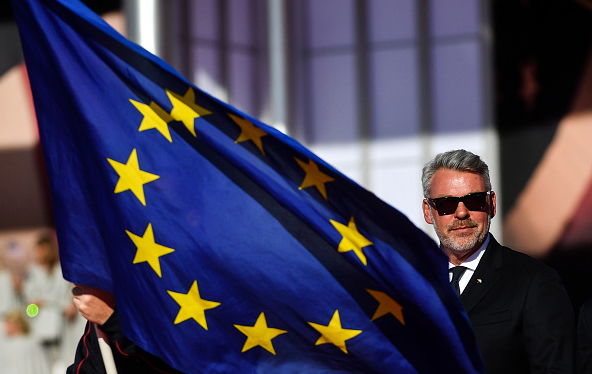
Europeans share regional institutions, extensive economic and political ties, recurring sporting competitions, a recognizable European flag and decades of Ryder Cup history built around that collective identity.
The International Team is something entirely different.
Its theoretical constituency ranges from established democracies such as Canada, Japan, South Korea and Australia to radically different political systems across the Middle East and Asia, including Iran, Afghanistan, Saudi Arabia, China, Cuba and North Korea, and then across developing and fragile states from Yemen and Syria to Somalia and Uganda.
These countries aren’t members of some shared International Union.
They don’t have an International parliament.
There is no International anthem.
There is no shared International history.
There isn’t even an International continent.
Their unifying principle is essentially that somebody at PGA Tour headquarters opened a world map, colored the United States one shade, Europe another, and said: “Everything left over goes on the other team.”
That is not a national identity.
That is the remainder column in Excel.
151 vs. 1
And this is where the whole thing becomes wonderfully absurd.
The United States gets one country.
The International Team gets almost everything else outside Europe.
One side gets California and a bunch of SEC states.
The other theoretically gets Canada, Australia, Japan, Korea, China, India, South Africa, Brazil, Argentina, Mexico, Saudi Arabia, Indonesia and a giant chunk of the remaining planet.
151 vs. 1.
Population? Not close.
Land mass? Not close.
Number of time zones? Absolute massacre.
Potential talent pool? At least on paper, the United States should need congressional authorization just to tee off.
Imagine explaining the competition to somebody unfamiliar with golf.
“So who does America play?”
“Everyone else.”
“Everyone?”
“Well, except Europe.”
“So basically the rest of the world?”
“Correct.”
“And who usually wins?”
“The United States.”
Pause.
“So… what exactly are the other 150 countries doing?”
Excellent question.
The World’s Strangest Fan Base
The branding becomes even funnier when you start thinking about whom the International shield theoretically represents.
Somewhere underneath that black-and-gold flag sits a potential fan coalition including Canadians and Australians, Japanese and South Koreans, Saudis and Chinese, Cubans and Haitians.
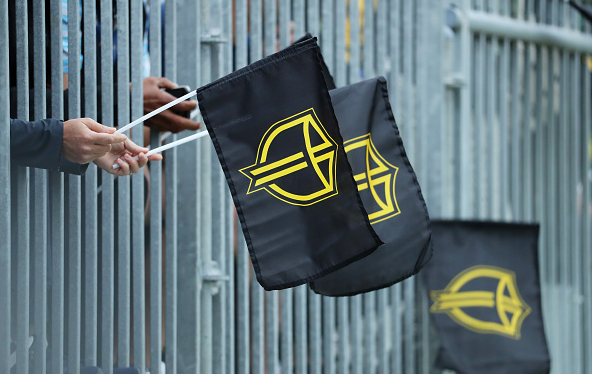
Nothing screams natural sporting brotherhood quite like: Ottawa + Tokyo + Riyadh + Havana + Pyongyang + Tehran + Melbourne + Seoul + Shanghai.
All united by their centuries-old shared cultural tradition of… not being located in the United States or Europe.
Picture the International Team marketing department trying to create the fan campaign.
ONE TEAM. ONE DREAM. 151 COMPLETELY UNRELATED COUNTRIES.
The Ryder Cup can put the European flag on a television graphic and viewers instantly understand what it represents.
The Presidents Cup International flag is essentially the flag of Elsewhere.
Maybe Geography Isn’t the Problem
None of this diminishes the players themselves.
The International Team has featured extraordinary golfers from Australia, South Africa, Canada, Japan, South Korea and elsewhere. Those countries have real golf traditions and passionate golf audiences.
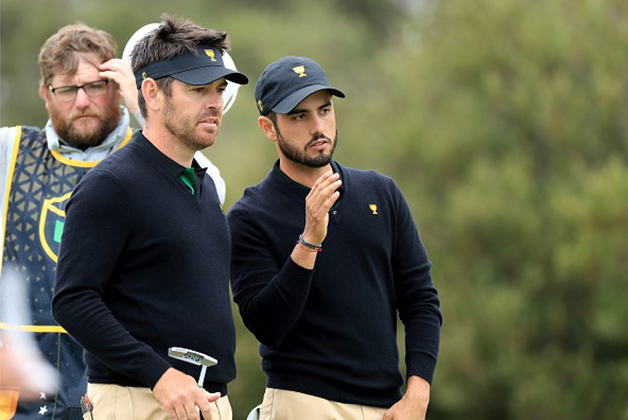
The problem is trying to combine them into one emotionally coherent sporting identity.
Team competitions work because fans feel that the team represents something recognizable.
Country.
Region.
History.
Culture.
The Presidents Cup instead asks a Canadian golf fan to feel an inherent sporting kinship with a South African, Australian, Japanese and Korean golfer simply because none of them qualify for the Ryder Cup.
That is a difficult emotional product to manufacture.
And perhaps that is why the Presidents Cup so often feels like a collection of excellent golfers wearing the same shirts rather than the visceral international confrontation the Ryder Cup became.
Europe has spent generations developing a broader European identity.
The Presidents Cup created one by exclusion.
USA on this side.
Europe over there.
Everybody remaining: congratulations, you’re teammates.
If this were Risk, America would surrender before breakfast.
If it were diplomacy, Washington would be begging for allies.
If it were a population contest, the mercy rule would already be under discussion.
But this is the Presidents Cup.
So somehow the one-country team with a population of 349 million keeps showing up looking perfectly comfortable while the coalition representing 7.2 billion people searches for chemistry.
Has anyone checked whether Greenland has a 17-year-old scratch golfer?