
















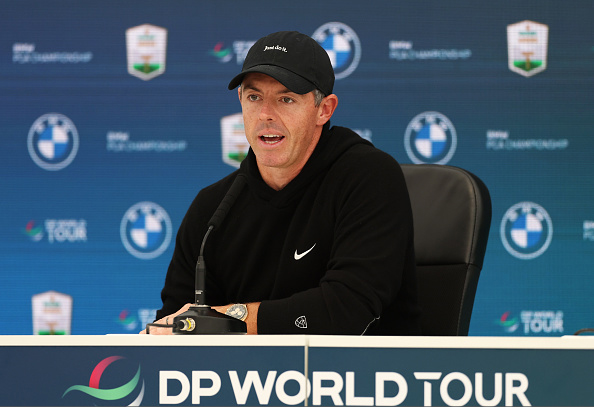
If Brian Rolapp is looking for players to sell the importance of every week on the PGA Tour, Rory McIlroy may not have delivered the ideal promotional message Tuesday.
Speaking ahead of the BMW PGA Championship at Wentworth, McIlroy repeatedly offered comments that revealed an unmistakable level of indifference toward the week-to-week PGA Tour product — particularly when compared with the majors and European golf.
And coming from McIlroy, those comments carry considerably more weight.
For much of golf’s civil war over the last several years, no player has been more publicly identified with the PGA Tour. McIlroy became one of its loudest defenders during the emergence of LIV Golf, served on the TOUR’s Policy Board and frequently functioned as the unofficial player spokesman for the traditional establishment.
Yet Tuesday, the six-time major champion sounded much less emotionally attached to life on the American circuit.
The most revealing admission came when McIlroy was asked about maintaining motivation after winning consecutive Masters titles in 2025 and 2026.
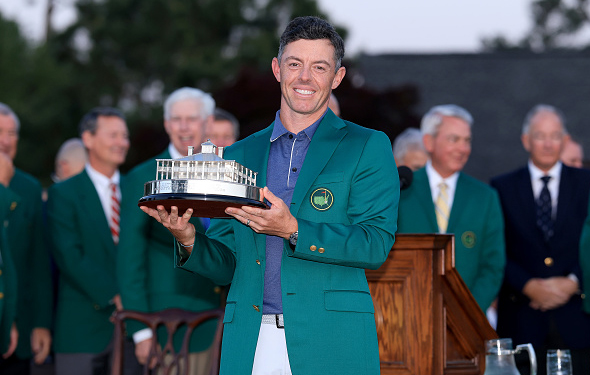
McIlroy acknowledged that after accomplishing such an enormous goal, some tournaments between the majors can begin to feel more like calendar fillers than destinations.
“There was still an underlying — not for the major championships, but for some of the other events that you feel like you’re just filling time to get to the next major championship in some ways,” McIlroy said.
McIlroy said he struggled with that feeling more significantly after his 2025 Masters victory and handled it better this season. Still, the underlying message was difficult to miss.
For one of the PGA Tour’s biggest stars, there are weeks when regular Tour events essentially become connective tissue between the championships that truly matter.
That is an awkward sentiment for an organization attempting to convince fans that its regular-season tournaments should carry greater consequence.
And that wasn’t the only interesting aside.
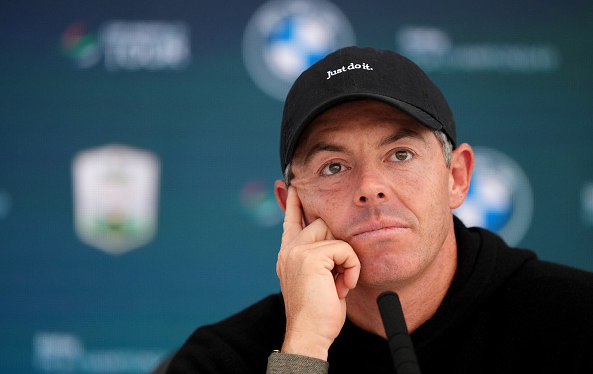
Asked whether he watched much of Europe’s Solheim Cup victory, McIlroy said he had not, although he did see footage of the Americans “drinking beer and chanting on the bus” Saturday night.
He then celebrated Europe’s victory and quickly broadened the thought to international team golf.
“Obviously a great result for the European side, after what we did in Bethpage, what the Walker Cup guys did,” McIlroy said.
Then came the curious part.
“All we need now is the Internationals to do it in a couple of weeks. That would be great.”
In other words, McIlroy is apparently hoping the United States loses the Presidents Cup, too.
Unlike the Ryder Cup, McIlroy has no European horse in that race. The Presidents Cup is the United States against an International Team that specifically excludes Europe.
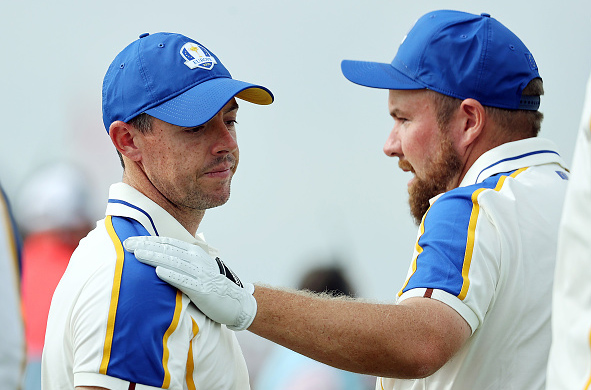
Maybe it was simply some lighthearted transatlantic rivalry. Maybe McIlroy was enjoying a recent run of American defeats in team golf.
But it was still a strange comment from a player whose professional career has been so deeply intertwined with the American golf ecosystem.
McIlroy resides part-time in the United States, has made enormous portions of his career earnings there and has spent years defending the PGA Tour against outside challengers. Yet Tuesday he sounded positively delighted by the idea of another American team losing.
At minimum, it added another fascinating layer to an interview already heavy with distinctly European sentiment.
McIlroy was then asked about the PGA Tour’s new competitive structure, which will eventually divide players between an elite Championship Series and a secondary Challenger Series.
He wasn’t particularly enthusiastic about the lower tier.
“I don’t see any reason why a DP World Tour player would go to the Challenger Series,” McIlroy said. “I don’t see that as an upward move in your career.”

Instead, he called it “a very lateral move.”
McIlroy doubled down moments later, saying he believes many DP World Tour players would feel similarly and arguing that successful European players should have a direct pathway into the elite Championship Series rather than leaving Europe for America’s second tier.
That is hardly a ringing endorsement for a new product the PGA Tour hopes will become an important component of its future ecosystem.
McIlroy’s message to European players was essentially simple: unless you’re advancing directly into the Tour’s top division, staying in Europe may be every bit as attractive.
Then came perhaps the most interesting answer of the afternoon.
Asked whether he could envision eventually playing the majority of his schedule on the DP World Tour, McIlroy didn’t hesitate.
“I’d love to envision a day like that,” he said.
The problem, McIlroy explained, is maintaining PGA Tour membership. Players must compete often enough and perform well enough to remain eligible at the highest level.
“One day maybe,” McIlroy said. “One day that would be really, really nice and finish my career where I started my career.”
McIlroy never explicitly said money is what keeps him playing in America, and it would be unfair to put those words in his mouth.
But the practical reality hardly requires extensive translation.
The PGA Tour remains the financial and competitive center of elite week-to-week professional golf. Its largest purses, world ranking points, sponsor opportunities and elite fields make maintaining membership enormously valuable.
McIlroy’s comments suggested something slightly different emotionally.
Europe increasingly sounds like where he wants to be.
America sounds like where, during the prime of his career, it still makes professional sense to be.
None of McIlroy’s comments individually amounted to an attack on the PGA Tour or the United States.
In isolation, every one has a reasonable explanation.
Majors are more important than regular tournaments. The DP World Tour is legitimate elite professional golf. McIlroy understandably feels a deep attachment to Europe. And rooting for an International Presidents Cup team could simply be harmless sporting banter.
But taken together, the comments created an unusual picture.
The player who spent years as arguably the PGA Tour’s most recognizable ambassador essentially said ordinary tournaments sometimes feel like something to get through before the next major; the Tour’s new Challenger Series isn’t necessarily a promotion over playing in Europe; he hopes the Americans lose another international team competition; and his ideal late-career scenario may involve spending most of his time back on the DP World Tour.

That is hardly the promotional script Rolapp would draw up while attempting to build the next generation of the PGA Tour.
In fact, it exposes one of the Tour’s larger challenges.
Rolapp can restructure fields, build promotion and relegation systems, increase purses and create a more exclusive Championship Series.
What he cannot manufacture is emotional importance.
McIlroy inadvertently illustrated his own hierarchy Tuesday.
The majors sit at the top.
Europe still feels like home.
And the PGA Tour, even for the man who spent years defending it most aggressively, increasingly sounds like the place he needs to play rather than the place he most wants to play.
For the longtime voice and face of the PGA Tour, that might have been the most revealing message of the entire afternoon.